

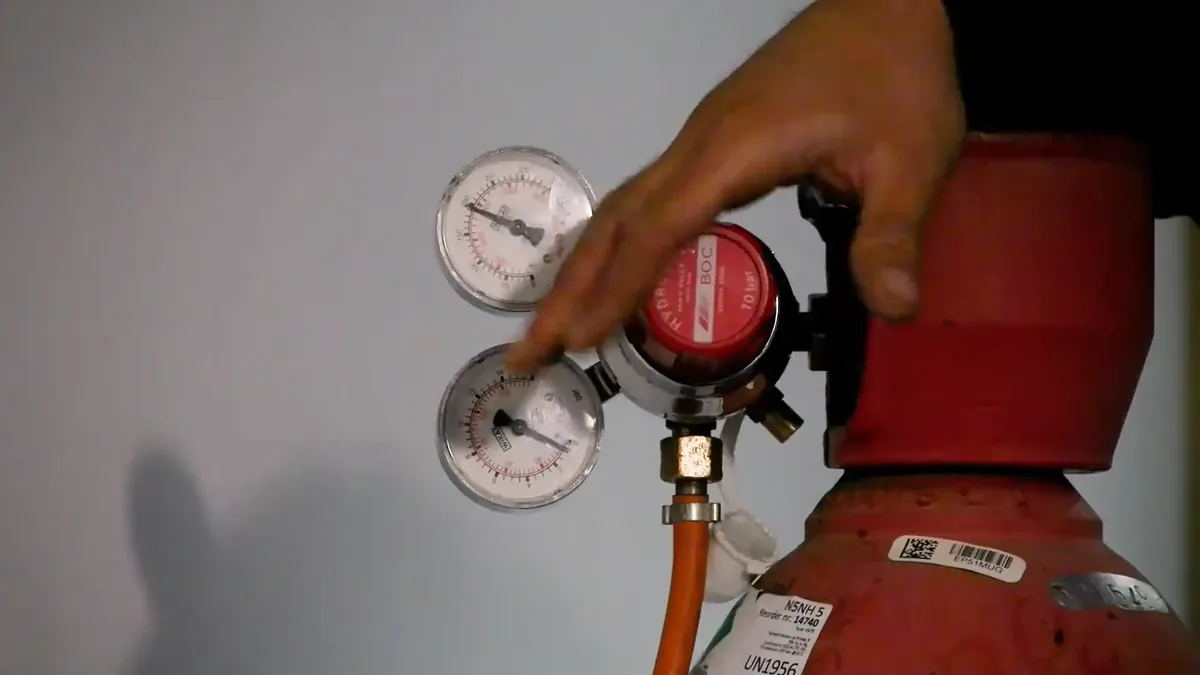
Tracer Gas Leak Detection in Westminster, CO
Westminster homeowners dealing with tracer gas leak detection can reach our team at (303) 552-3896. We use non-invasive acoustic, thermal, and tracer-gas technology to locate the failure point before any wall or slab opening work begins. Licensed in Colorado through DORA. Serving all of Westminster, Adams and Jefferson Counties.
Tracer gas detection uses a 5% hydrogen / 95% nitrogen mixture pressurized into an isolated pipe section. Hydrogen molecules migrate through micro-fractures in pipe walls and surrounding soil or concrete that water cannot penetrate efficiently, then rise to the surface where a sensor detects the gas concentration peak directly above the failure point. Effective for Westminster slab leaks, foundation cracks, and underground pipe failures where acoustic methods produce ambiguous signals.
What Causes tracer gas leak detection in Westminster
Westminster straddles the Adams and Jefferson county line, and the two county sides of the city present different foundation types that benefit from tracer gas detection in different ways. The older Adams County-side neighborhoods in Westminster Heights, Hilltop Westminster, and the Harris Park area have a mix of block foundation, poured concrete basement, and crawlspace configurations from the 1950s and 1960s. Micro-cracks in block foundation cores and hairline cracks in 60-year-old poured concrete walls are small enough that water seepage through them is intermittent and acoustic detection at the surface is impractical. Tracer gas injected into the suspected crack or pipe section migrates through these micro-fractures and reaches the surface detector at concentrations that confirm the failure location without any wall opening. The Jefferson County-side Westminster neighborhoods have newer poured concrete construction where tracer gas is most commonly used for slab supply line failures that acoustic and ultrasonic methods have not precisely located.
Westminster's tracer gas detection service is deployed as the resolution tool when prior detection methods have confirmed a leak exists but have not located it precisely. A Westminster Heights home where pressure testing confirms a supply leak but acoustic scanning produces an ambiguous signal across a 6-foot zone in the crawlspace wall is a tracer gas candidate. A Crown Pointe Westminster home where a slab leak is confirmed by pressure test and thermal imaging has identified a warm floor zone but acoustic detection has not produced a precise cut-point is a tracer gas candidate for the remaining location step. Tracer gas is also the primary detection method for Westminster drain pipe micro-cracks in foundation assemblies where the drain system is not pressurized and acoustic detection of water flow is not applicable.
Tracer Gas Leak Detection: The Westminster Detection Process
Westminster tracer gas detection begins by isolating the suspected pipe section and pressurizing it with the hydrogen-nitrogen gas mixture at a pressure below the pipe's safe working pressure. For supply lines, the section is isolated using the available shutoff valves and an inline pressure gauge monitors the gas pressure to confirm the section is holding the gas rather than leaking it too rapidly for detection. For drain lines, the section is isolated with test plugs at access points and pressurized with gas. After the pressurization phase, the gas is allowed to migrate through the surrounding material for the appropriate dwell time based on the pipe depth and material. The surface scan then sweeps the tracer gas sensor across the full suspected zone, with the sensor alarm triggering at the concentration peak above the failure point.
When you call (303) 552-3896, we ask three questions upfront: the approximate age of your Westminster home, your foundation type (basement, slab, or crawlspace), and whether you've noticed hot-spot flooring, a spike in your City of Westminster water bill, or unusual sounds from the wall. This pre-diagnosis shapes which detection tools we bring — so the right equipment arrives on the first visit.
Tracer Gas Leak Detection: The Repair Phase
Westminster tracer gas detection produces a precise failure location mark on the floor, wall, or yard surface that is confirmed by a secondary scan pass perpendicular to the first. The confirmed location is documented with the gas concentration readings at the failure point and the adjacent background readings, which establishes the accuracy confidence for the opening plan. The repair follows from the confirmed location: concrete cutting at the slab surface for slab supply failures, wall opening for foundation wall micro-cracks, or yard excavation for underground pipe failures. Westminster tracer gas detection is always paired with the applicable repair service as a combined appointment or a closely scheduled follow-on.
Westminster Water Chemistry and tracer gas leak detection
Westminster's Clear Creek surface water arrives at the Semper Water Treatment Facility and the Northwest Water Treatment Facility at a hardness of 100 to 135 parts per million, or roughly 7 to 8 grains per gallon. That sits in the moderately-hard category — harder than Denver's typical municipal blend at comparable pressure — and hard enough to deposit meaningful scale at copper sweated joints over a 20-to-35-year lifespan. Understanding Westminster's mineral load helps calibrate detection. The acoustic signature of water escaping through a scale-lined pipe differs from a fresh-cut copper failure, and our equipment accounts for Westminster's specific pipe-condition profile when interpreting signal strength across different neighborhood cohorts.
Common Questions About tracer gas leak detection in Westminster
Related Westminster Leak Services
Westminster tracer gas detection for slab supply line failures connects to our slab leak repair service for the concrete cutting and pipe repair after the gas locates the failure point. For Westminster foundation micro-crack failures detected by tracer gas, the repair connects to our foundation leak service. Westminster homeowners who want to understand which detection method is appropriate for their specific leak situation should start with our non-invasive leak detection service, which selects and deploys tracer gas, acoustic, thermal, or electronic methods based on the specific site conditions.